
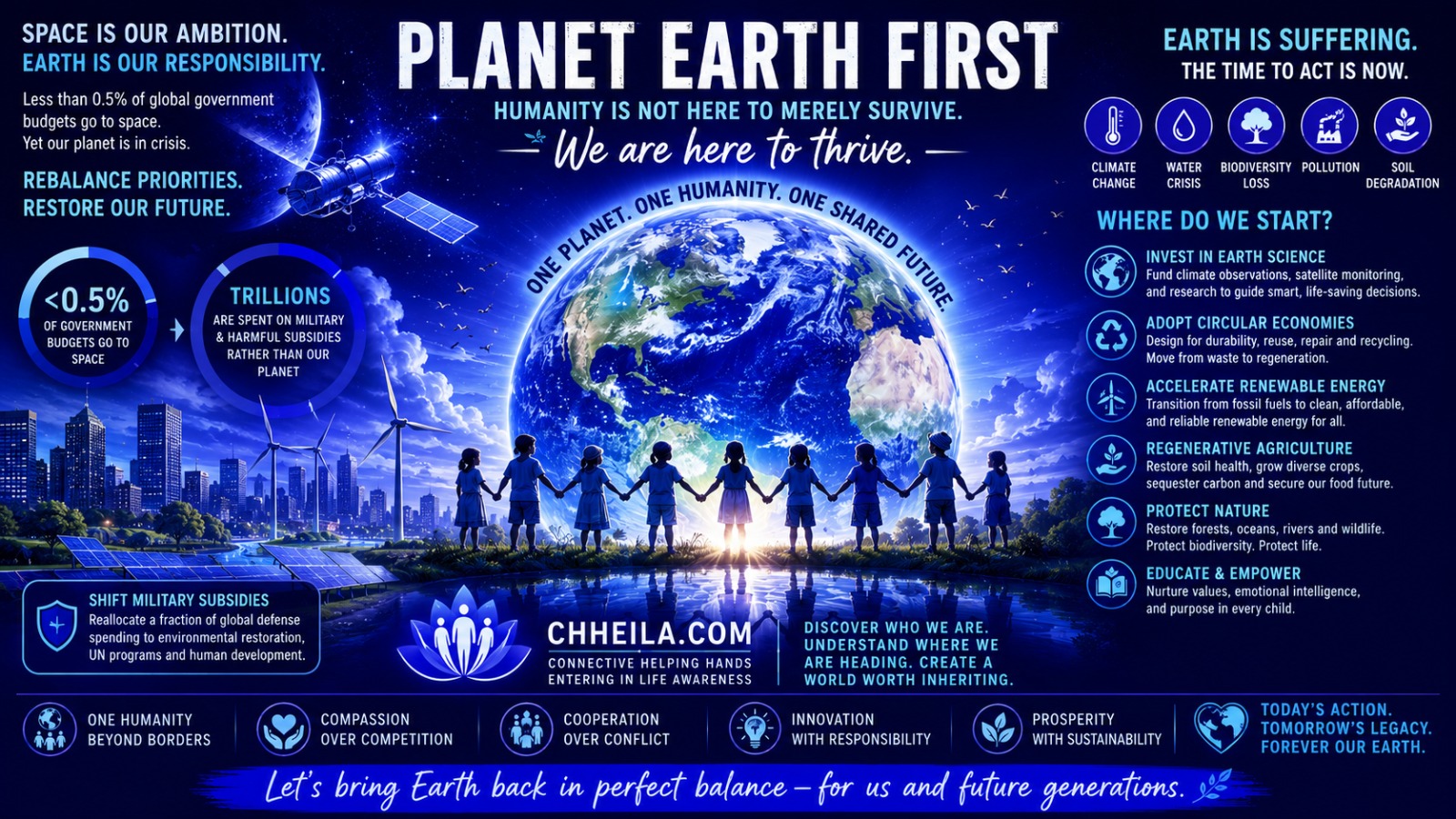
🌍 Planet Earth First: A Call for Responsible Leadership Before We Reach for the Stars
“There is no Planet B.”
Every generation is remembered for the choices it makes. Ours will be remembered for one fundamental question:
Did we protect the only home we have before chasing new worlds?
Human curiosity has always driven exploration. From crossing oceans to exploring the Moon and now planning missions to Mars, our desire to discover the unknown is one of humanity’s greatest strengths. Space research has produced extraordinary benefits, from satellite communications and GPS to weather forecasting, disaster monitoring, and scientific breakthroughs.
But curiosity must always be accompanied by responsibility.
Today, our greatest challenge is not whether humanity can reach another planet. It is whether humanity can preserve Planet Earth for future generations.
Earth Is Sending Us Clear Signals
Around the world we see growing evidence of ecological imbalance:
- Rising global temperatures.
- More frequent floods, droughts and bushfires.
- Loss of biodiversity.
- Pollution of rivers and oceans.
- Soil degradation.
- Freshwater shortages.
- Declining mental wellbeing linked to environmental uncertainty.
These are not isolated problems. They are interconnected symptoms of an ecosystem under increasing stress.
While governments continue investing in long-term scientific ambitions, including space exploration, the immediate responsibility remains protecting the only planet that currently sustains nearly eight billion human lives.
This Is Not Space vs Earth
This should never become an argument against science.
Space exploration has generated enormous benefits for humanity.
Earth-observing satellites help us:
- predict cyclones and bushfires,
- monitor climate,
- improve agriculture,
- manage water,
- coordinate disaster relief,
- understand environmental change.
These investments should continue because they directly strengthen life on Earth.
The real question is one of balance and priorities.
If humanity can invest extraordinary resources in reaching Mars, surely we can invest with equal determination in restoring forests, protecting oceans, improving education, strengthening communities, and ensuring every child inherits a healthy planet.
The Bigger Imbalance
The larger imbalance is not space research. It is the global allocation of resources.
Every year the world spends trillions of dollars on military capability, while investments in environmental restoration, preventive healthcare, education, biodiversity, and human development remain comparatively small.
Imagine if even a modest share of those resources were redirected toward:
- restoring degraded ecosystems,
- clean water projects,
- regenerative agriculture,
- renewable energy,
- scientific environmental research,
- early childhood education,
- community resilience,
- climate adaptation.
The return on investment would benefit every nation.
Where Do We Start?
Real change begins with a simple principle: Restore balance before expanding beyond it.
- Put Planet Earth at the Centre of Policy
Every major national decision should answer one question: “Will this leave the Earth healthier for future generations?” Economic growth should no longer be measured solely by GDP but also by environmental health, human wellbeing, resilience, and long-term sustainability. - Invest More in Earth Science
Earth observation deserves stronger support. Better satellite monitoring, climate modelling, biodiversity mapping, water management, and disaster prediction help governments make evidence-based decisions that save lives and reduce costs. - Build Circular Economies
Nature produces no waste. Human civilisation should strive for the same principle by designing products that are durable, repairable, reusable, and recyclable. - Restore Nature
Healthy forests, wetlands, rivers, soils, reefs, and oceans form Earth’s natural life-support systems. Protecting biodiversity is not merely conservation, it is safeguarding humanity’s future. - Accelerate Clean Energy
Energy independence and environmental responsibility can advance together through renewable energy, energy storage, efficiency, and innovation. - Regenerate Agriculture
Healthy soil produces healthy food. Supporting regenerative farming improves food security, biodiversity, water retention, and carbon storage while strengthening rural communities. - Educate the Next Generation
The greatest environmental solution may not be a new technology. It may be a generation raised to understand who they are, how nature works, why balance matters, and how every action influences future generations.
The Chheila Perspective
At Chheila.com, we believe humanity’s greatest discovery is not another planet. It is discovering ourselves.
The question is not simply: “Can humans survive elsewhere?” The deeper question is: “Can humanity learn to live wisely here?”
Real sustainability begins with human awareness. When children discover their uniqueness, develop emotional intelligence alongside knowledge, respect nature, and understand their responsibility toward one another, societies become more resilient, compassionate, and innovative.
The future depends not only on smarter technology, but on wiser human beings.
Technology without wisdom creates imbalance. Wisdom supported by technology creates civilisation.
Humanity Is Not Here to Merely Survive
We are here to thrive.
Thriving means creating harmony between humanity and nature, science and ethics, innovation and responsibility, prosperity and sustainability, Earth and future exploration.
Protecting Planet Earth does not mean abandoning our dreams of exploring the universe.
It means earning the right to explore it by first demonstrating that we can care for the extraordinary world that gave us life.
Perhaps the greatest achievement in human history will not be the first city on Mars. It will be the moment humanity learns to live in balance on Earth.
That journey begins today.
Because every child yet to be born deserves a planet that is not merely habitable, but thriving.
Planet Earth First. Humanity Together. Future Forever.